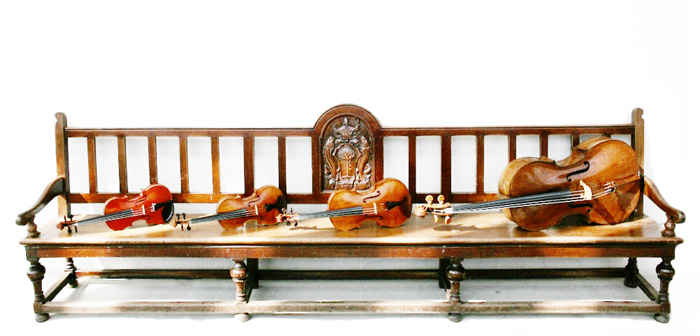
![]() Another string to their bows The evolution of a group of orchestral full-timers into a quartet has been slow, but worth noting, finds MICHAEL TUMELTY It sounds like a men's magazine but GSQ is, in fact, Scotland's newest classical music ensemble: the Glasgow String Quartet. Indeed, the group isn't particularly new, having been around for about 18 months now. But if the name is unfamiliar, then don't be surprised. You might expect that a new group would do everything within its power to make a splash, create an impact, establish a presence, and generate a profile, but the GSQ has adopted an approach which is almost a paradox in this age of near-paranoid hunger for publicity. There has been no marketing campaign, no quest for funding, no hammering on the doors of the media, and no approach to the promotional guardians who hold the key to Scotland's vast network of music clubs and societies. Quite the reverse. The GSQ has, instead, adopted a softly-softly approach, where development is more by natural evolution than naked ambition, where the group is watching carefully its own growth, where it is allowing things - in the words of its leader - "to unfold naturally", and where it has not yet decided just how far, or how hard, to push itself. In sum, the collective philosophy of the four players seems almost antithetical to the typical hard-drive, upfront, and in-your-face attitudes commonly struck by music organisations of any hue. Indeed, to date the GSQ has been almost discreet about its own existence. I became aware of the group only six weeks ago when, at the launch of the ScottishPower Proms in the opulent surroundings of Stefan King's fashionable Glasgow bar, Arta, the seductive tones of Ravel's string quartet, characterised by some classy playing, filtered through the hubbub of a typical press launch. This was the GSQ. Anyone remotely acquainted with the orchestral scene will instantly recognise the faces. They are all familiar as front-desk players in the string section of the RSNO. William Chandler, leader of the GSQ, is associate leader of the RSNO (and, indeed, led the orchestra last week on its Scottish tour of Mahler's First Symphony). Jacquie Speirs, second violin in the quartet, is associate principal in the second violins of the RSNO; Ian Budd, violist, is a veteran of the RSNO, having been in the viola section, of which he is associate principal, for 25 years; and cellist Betsy Taylor is assistant principal of that section in the orchestra. They are all contract, salaried players in the RSNO; which, at an obvious level, is one reason why they don't feel the need to drive hard to gain the limelight. As William Chandler, American-born and a violinist in the Houston Symphony Orchestra before he moved to Scotland, puts it: "We don't need this to pay the rent or the mortgage." But the main reason for the group's relative restraint to date, apart from the demands of the players' full-time jobs, is that they never set out to be a quartet in the first place. They got together 18 months ago following a request to Chandler by members of the community in Balfron, where he lives, to put together a group to help with a fund-raising event. On one level, he says, there was "so much fun, enthusiasm, and goodwill" associated with the experience, that they decided to do it again. But there was another factor, which intrigued them. "There seemed to be something very easy about playing together. There was something that seemed to fit. We noticed it immediately." Last spring they did a second concert for the community, and noticed the same again, that there seemed to be a rapport and a musical blend that was unforced and natural. Intrigued further, the four of them then called in trusted critical colleagues from the RSNO for an objective assessment. Their own instinctive response was confirmed. Unanimously, they were advised to "go with this", and were told that they actually sounded like a string quartet, as opposed to merely a group of four orchestral players who had got together to read through some music. That was the start of it. A concert for the Architectural Heritage Society of Scotland followed, then a concert in St Cuthbert's Church in Edinburgh for the Friends of the RSNO, the Arta gig at the proms launch, and a lunchtime concert last week in Aberdeen, promoted by the city council. |
This Sunday, the GSQ has a major full-scale concert in Stirling, at the Tollbooth, featuring quartets by Haydn and Ravel, Shostakovich's seventh quartet, and the UK premiere of Michael Torke's quartet entitled Corner in Manhattan, and given to the group by the composer. So is this the big, belated launch of the group? Hard to say. Certainly, there is a growing element of drive, but there are issues to resolve. "The time commitment is the biggest thing," says William Chandler. "We're really bumping heads about this: finding time to sit down and talk about what we want to do, to bounce ideas off each other, and to prepare." Rehearsals are snatched in lunch hours, diaries are sorted out during breaks, text messages fly continuously, and car journeys to RSNO concerts become precious opportunities for intensive discussions. "We had a fantastic journey to Aberdeen last week - two hours in the car together to talk about repertoire, how much we can take on, how far we should set our goals this year, and how far are we going to go with this. So far we have had to draw lines and set limits on how many projects we can take on. "The orchestra does many things for us, and is the infrastructure of our musical lives. But you can't get everything you want out of your musical life from one basket, as it were," says Chandler, raising the perennial issue for the full-time orchestral musician. As a player in an orchestra, your mind is not your own. Your immediate musical destiny - what you play and how you play it - is in the hands of other people, from administrators to conductors. Any individual musical urge and instinct you might have has to be suppressed, sublimated, or channelled according to the direction, whim, and control of the conductor. "In a group of 90 individual musicians, all experienced, all with something to say, the nature of the beast is that you always do what somebody else tells you to do - not just what, but how, when, where, and why. It has to be an undemocratic set-up in order to make an artistic statement - the large group has to be under someone's guidance and control. There's a lot of rigorous discipline involved. But in that equation the artistic and creative input from the individual is narrow and limited - and it's probably safe to say that you have to stifle it." The quartet is, he says, a "fantastically liberating and democratic experience", and one that brings new challenges both personal and technical. There can be, says Chandler, no divas and no domination. "We've had to find ways to communicate and come to consensus about musical decisions." Technically, the switch they have to make from their day-job modes of playing is fascinating. "Making the mental switch from playing a Tchaikovsky symphony to a Haydn quartet is not just a huge jump: it's acrobatic. It's a very different kind of playing in the small group, from the way you produce the sound to the required projection. In the orchestra, we're always trying to be one large, whole, organic being. In the quartet, there's a completely different chemistry." He adds: "In the orchestra, as a violinist, you make a sound which has to be a blended fraction of the whole of your section, and an even smaller fraction - one ninetieth - of the whole orchestral sound. It's a tiny part of a big puzzle. In the quartet, you're a much bigger chunk of a smaller puzzle. The pianissimo you play in an orchestra is completely different from the pianissimo in a quartet, where you have to play to be heard, where you have to sing." From dealing with the nuts and bolts, to the big picture of repertoire-learning and concert engagements, the GSQ is on a rising curve, and there is probably an issue around the corner. After the summer, the group has two engagements for Westbourne Music, a gig back in Balfron, where it all started, and several major concerts associated with an RSNO project in the orchestra's new season, to be announced in a fortnight. Things are moving, and the pressure on the GSQ, which has the blessing of the RSNO executive, is likely to intensify. "We're not in a rush to splash out," says Chandler, firmly resisting any pressure. "At the end of this year I think we'll take stock, see where we are, and maybe make a push into the music club scene and try to put a few tours together. The quartet is a natural evolution from what we do. It's in our own hands, and we haven't lost the control yet." GSQ: the Tollbooth, Stirling, Sunday, 7.30pm. - April 10th |
|
![]() |
||
|
|
||